Most San Diego homeowners don’t notice their weatherstripping until their energy bill climbs or they feel a draft on a June morning with the AC running. By then, the seals have usually been failing for months — quietly letting conditioned air out and dust, noise, and marine humidity in.
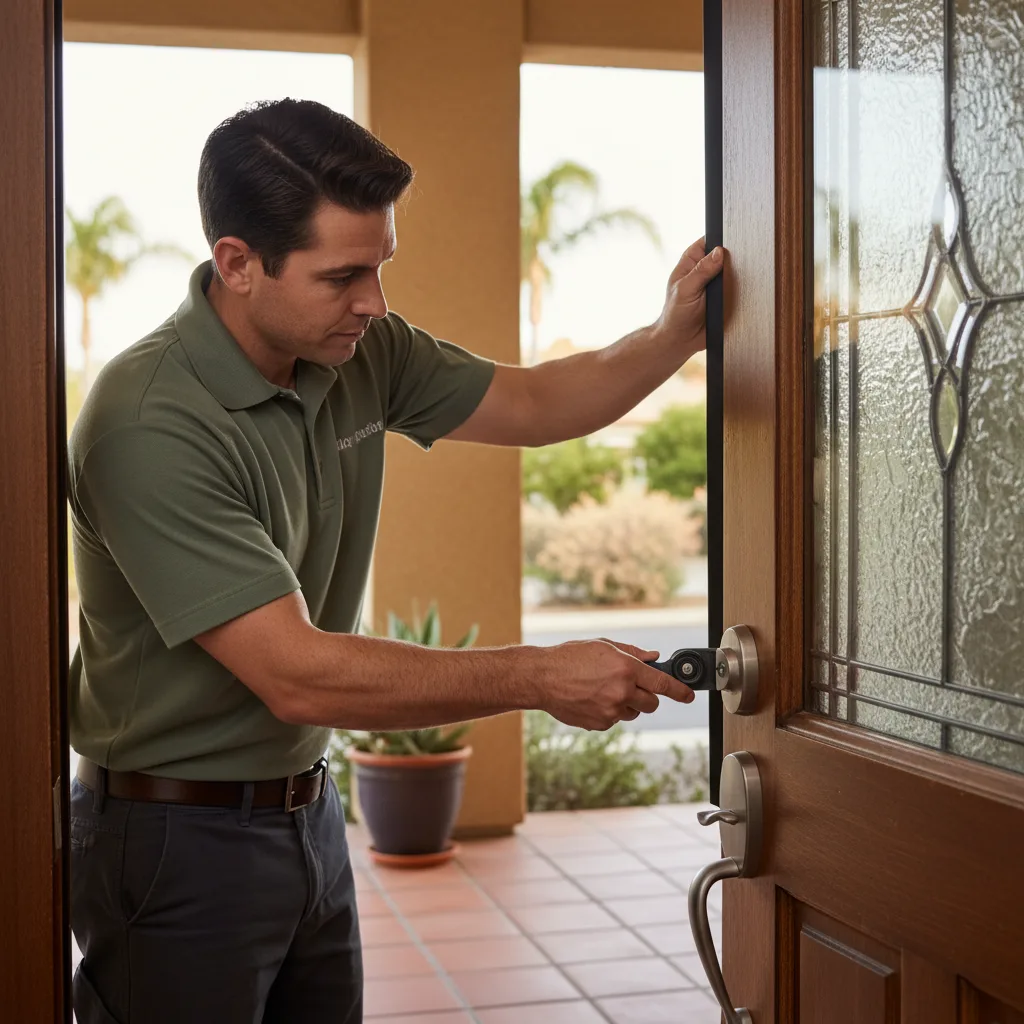
How San Diego sun and salt break down weatherstripping
Coastal Southern California is harder on door and window seals than most people expect. The UV index in San Diego averages in the high range nearly year-round, and any seal facing west or south takes direct sun for four to six hours a day across every season — not just summer. That continuous UV exposure is the number one reason foam and vinyl seals crack and compress prematurely here compared to inland or northern climates.
Salt air compounds the problem. Within a few miles of the coast — think Pacific Beach, Ocean Beach, La Jolla, Coronado, and Encinitas — airborne salt crystals work into porous materials and accelerate oxidation. Metal carriers on door sweeps corrode. Adhesive-backed foam tape loses its bond. Vinyl V-strips become brittle.
The result is that weatherstripping in San Diego typically lasts four to seven years on sun-exposed doors, compared to the ten-plus years you’d expect in a shaded or inland installation. If your home is older and nobody has touched the seals since original construction, there’s a good chance everything is overdue.
Temperature swings matter less here than in colder climates, but the daily thermal cycle — cool marine mornings, warm afternoons — does cause expansion and contraction that gradually degrades adhesive bonds over time. That’s worth knowing when you’re choosing a replacement material.
The four types of door weatherstripping and where each one fits
Door weatherstripping isn’t one product. There are four common types, and they work in different spots on the door assembly.
Door sweeps attach to the bottom interior face of the door and drag lightly across the threshold. They’re the most visible type and the most frequently replaced. Automatic drop-down sweeps are worth the upgrade on exterior doors — they lift slightly when the door opens so they don’t scrape and wear as quickly.
Kerf-in V-strip is the most durable option for the door stop — the thin strip of wood your door closes against on the jamb. A router or table saw cuts a narrow slot (a kerf) into the stop, and the V-strip presses in and locks without adhesive. Because it doesn’t rely on glue, it holds up well in San Diego’s heat. It’s harder to install cleanly without experience, but it lasts.
Adhesive-backed foam tape is the easiest DIY option and the fastest to fail in this climate. It works fine on interior doors or low-sun applications. On a west-facing front door, expect two to three years before it compresses flat and stops sealing.
Magnetic seals are common on steel doors and some French doors. They work the same way a refrigerator seal does — a flexible magnetic strip pulls the door tight at contact. They don’t degrade from UV as fast as foam, but they can tear or lose magnetic strength over time, especially if the door has settled and no longer closes flush. If your door has a sticking or alignment problem, fix that before replacing a magnetic seal or the new one will wear unevenly in the same spot.
Window seals: vinyl, foam, and silicone bulb
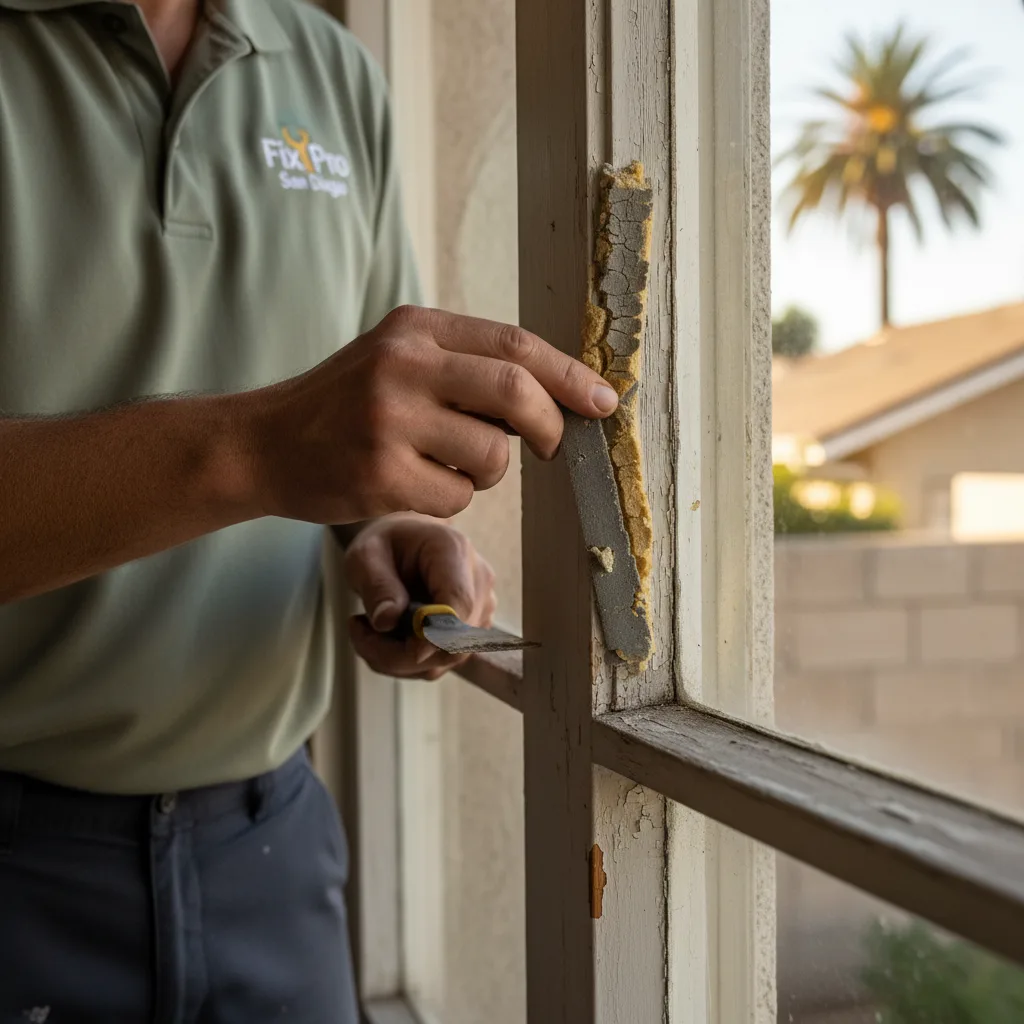
Windows use smaller-profile seals than doors, but the same failure modes apply. The three materials you’ll encounter most on San Diego homes are vinyl, open-cell foam, and silicone bulb.
Vinyl pile weatherstripping — that fuzzy strip that looks like a tiny brush — is standard on sliding windows and sliding glass doors. It compresses slowly over years rather than cracking, so it’s not always obvious when it’s gone. Run your hand along the track after a windy day. If you’re collecting dust inside the frame, the pile is worn down.
Open-cell foam is common on double-hung windows, pressed into the channel where the sash meets the frame. It’s cheap and easy to swap, but it absorbs moisture, which is a problem in coastal neighborhoods with morning marine layer. Compressed foam that’s holding moisture is a mold risk — pull it out and replace it with closed-cell foam or silicone bulb instead.
Silicone bulb seal is the most weather-resistant option for windows in San Diego. It compresses under pressure and springs back cleanly, handles UV without cracking, and doesn’t absorb water. It’s more expensive than foam — roughly $1.50 to $3.00 per foot versus $0.30 to $0.60 for foam tape — but it lasts significantly longer on south- and west-facing windows.
Our caulking and sealing service often pairs with weatherstripping work because the two jobs address different parts of the same envelope problem: seals handle the moving joints, caulk handles the fixed gaps between frame and wall.
Signs you’ve got an air leak vs a water leak
Air leaks and water leaks can look similar from inside the house, but they have different causes and different fixes.
Air leak signs: You feel a draft near a closed door or window. A candle flame or incense smoke wavers when held near the frame. Your cooling bill spikes in May or June without an obvious cause. The room nearest the front door stays noticeably warmer than the rest of the house.
Water leak signs: You see staining or soft drywall at the base of a door frame after rain. The threshold wood feels spongy underfoot. Paint on the interior face of the door jamb is bubbling. There’s a visible gap between the door frame and the siding outside.
Air leaks almost always mean worn weatherstripping. Water intrusion usually means a failed door sweep combined with a caulk failure at the exterior frame — that’s a two-part fix. In some cases, a door that’s settled out of square lets water in at the corner because the sweep no longer makes full contact across the threshold. That requires adjusting the door before sealing will hold.
If you’re seeing water damage inside the frame, check our door repair service page — there’s often a structural component to address before weatherstripping alone will solve the problem.
Replacement cost: DIY parts vs handyman call
Parts for a standard exterior door — door sweep, kerf-in V-strip for three sides of the jamb — run $25 to $60 at a hardware store. A full window seal replacement for a double-hung window costs $8 to $20 in materials.
The labor is where it gets complicated. Kerf-in installation requires a router setup and a steady hand. Door sweeps need to be cut to width and set at the right height so they seal without dragging hard enough to wear through in a season. Get the height wrong by 1/8 inch and you’re either not sealing or you’re creating resistance that strains the door hardware.
A handyman visit to re-seal a front door typically runs $75 to $150 including parts, depending on what’s there. Doing all the exterior doors and a few windows in a single visit brings the per-door cost down. That’s usually the smarter call — everything gets done at the correct gap, and you’re not repeating the job in 18 months.
For context on how DIY vs. professional repair math works out on home projects generally, this cost comparison for San Diego homeowners breaks down the tradeoffs clearly.
Quick fixes that buy you a year
If a full replacement isn’t in the budget right now, a few temporary measures help.
Adhesive-backed closed-cell foam tape over existing compressed foam buys time on interior or shaded doors. It’s not a long-term fix, but it costs under $10 and takes 20 minutes. Door draft stoppers — the fabric tubes you push against the base of a door — are surprisingly effective for indoor air leaks in a pinch.
For windows, a bead of removable window caulk (the kind that peels off cleanly) can seal a cracked or missing vinyl pile strip through the winter. It’s not pretty, but it works. Clear it out and do the proper repair in spring.
These patches work best on north-facing openings that don’t take direct sun. On a south or west exposure, expect adhesive-backed products to fail within a season regardless of brand.
When to call us
Weatherstripping is one of those jobs that looks simple but rewards experience — specifically on the fitting and alignment details that make the difference between a seal that lasts and one that fails in eight months. If your door has multiple seal types to replace, if you’re seeing signs of water intrusion alongside the air leak, or if the door itself needs adjustment before sealing will work, it’s worth having someone who does this regularly handle it in a single visit.
Call us at (858) 808-6055 for same-day handyman service across San Diego County.