Paint doesn’t fail because of bad paint. It fails because the surface underneath wasn’t ready. On San Diego stucco, that gap between a paint job that looks great for two years and one that lasts eight comes down almost entirely to what you do before the first drop of primer hits the wall.
Why prep matters more than paint on stucco
Stucco is porous. That’s what makes it so popular in Southern California — it breathes, it handles temperature swings well, and it’s been the default exterior finish in San Diego since the mid-20th century. But that same porosity means it soaks up moisture, salts, and airborne debris. Over time, those contaminants sit between the old paint film and the new coat you’re trying to apply. When that happens, adhesion fails — usually within 18 months.
San Diego’s climate accelerates this. Coastal neighborhoods like Ocean Beach, Mission Hills, and Pacific Beach deal with marine layer moisture six months a year. Inland areas like Santee and El Cajon swing 30-plus degrees between summer afternoon highs and winter nights. Both patterns stress stucco differently. But both share the same prep requirement: start clean, start solid, or don’t start at all.
A mid-grade exterior paint applied over properly prepped stucco will consistently outlast a premium paint applied over dirty, cracked, or chalky surfaces. That’s not an opinion — it’s what paint manufacturers state in their own application guides. The paint is almost the last decision you make. The prep work is every decision before it.
Hairline crack repair before primer
Stucco cracks. Not because something went wrong — because concrete-based materials shrink slightly as they cure, and because San Diego homes settle over decades of seismic micro-movement. Most of what you’ll find on a typical 1960s or 1970s ranch house in Clairemont or Lemon Grove are hairline cracks: less than 1/16 inch wide, mostly cosmetic, but capable of channeling water behind your paint film if left open.
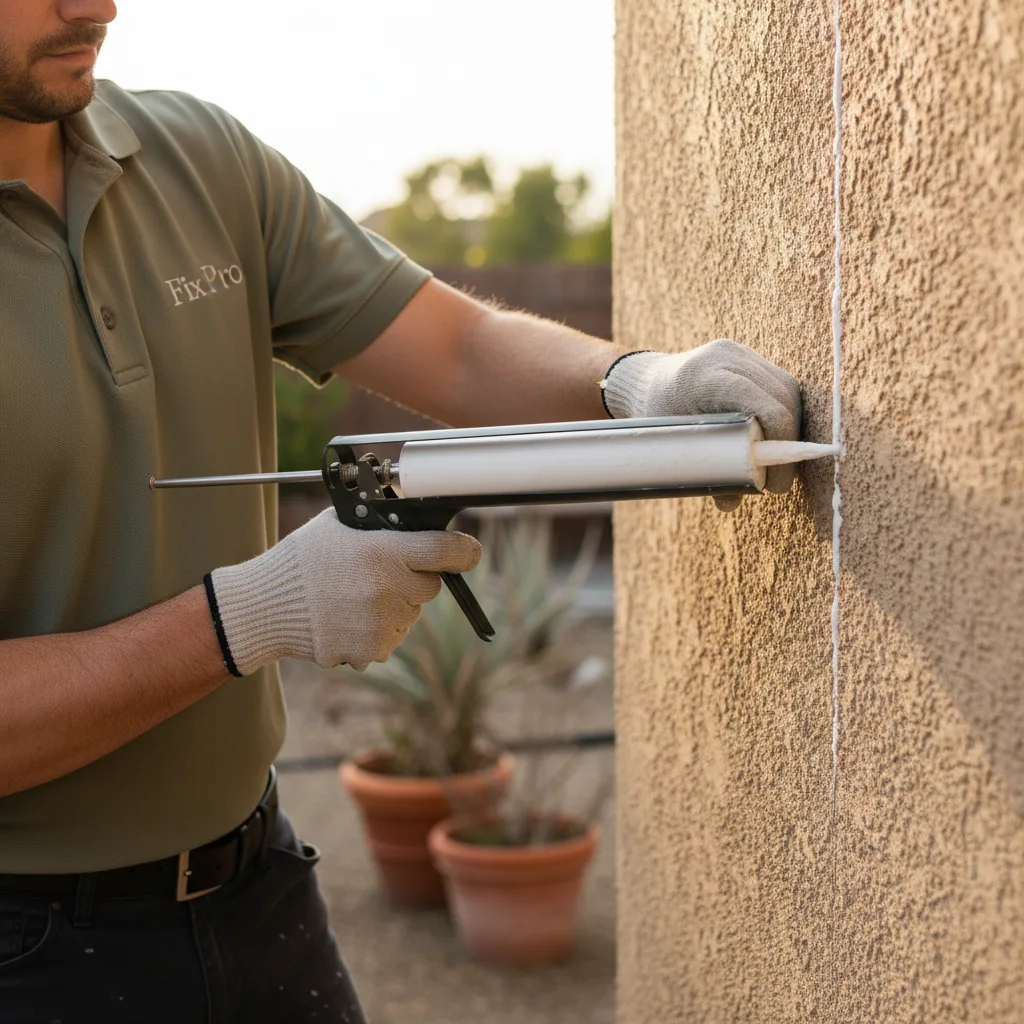
The repair approach depends on crack width. Hairline cracks — thin as a pencil line — respond well to a flexible paintable caulk or an elastomeric crack filler rated for masonry. You’re not filling a void so much as sealing a seam. Wider cracks, from 1/8 inch up, need a patching compound: a pre-mixed stucco patch or a two-part acrylic filler that can be textured to match the surrounding finish.
A few rules that apply to all stucco crack repair:
- Let all patches cure fully before priming. Most products need 24-48 hours at San Diego’s typical 65-75°F spring temperatures.
- Match the texture. A filled crack that’s flat in a skip-trowel finish will telegraph right through paint.
- Don’t use standard interior spackling on exterior stucco. It’s not vapor-tolerant and it will fail within one season.
For the caulking side of this work — window perimeters, door frames, where stucco meets wood trim — our caulking and sealing service covers exactly this. It’s the part most homeowners either rush or skip entirely, and it’s where water infiltration most commonly starts.
Power washing vs hand scrubbing — when each one is right
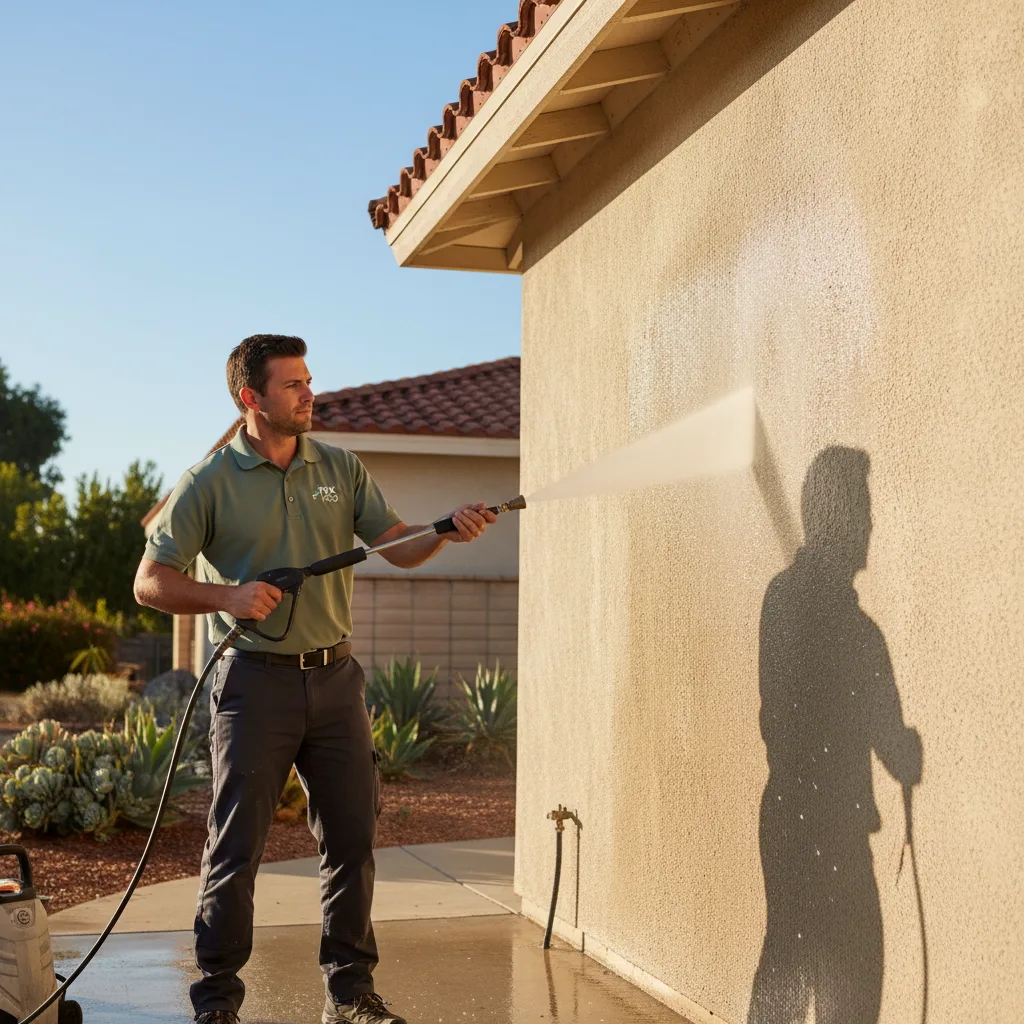
Pressure washing is almost always the right first move on San Diego stucco. It strips chalky oxidized paint, kills surface mold and algae (common in shaded north-facing walls), and clears the salt deposits that build up in coastal zip codes. A clean surface means your primer bonds to stucco, not to a layer of loose contamination.
The specifics matter, though. For standard stucco in good condition, 1,500 to 2,000 PSI with a 25-degree fan tip is enough to clean without gouging. Soft stucco — older homes with thin-coat finishes or any surface that sounds hollow when you tap it — needs to stay under 1,200 PSI. If you’re unsure, start at the lowest pressure and work up. You can’t undo a gouge.
Hand scrubbing makes sense in two situations: small sections with stubborn mildew that the pressure washer didn’t fully clear, and areas immediately adjacent to rotted wood, unsealed trim, or any surface you don’t want saturated. A stiff-bristle brush with a diluted trisodium phosphate (TSP) solution handles both. Rinse thoroughly — TSP residue interferes with primer adhesion.
After washing, wait. Stucco needs to dry completely before primer goes on. In San Diego’s spring weather, that typically means 48 hours minimum. If you’re prepping during a stretch of marine layer mornings in May or June, add another day. Damp stucco under a sealed primer coat is a blister waiting to happen.
Our pressure washing service is one of the most common pre-paint calls we get, and we’ve put together a full pressure washing guide for San Diego homes if you want to go deeper on technique and equipment choices.
Coastal vs inland prep: what changes between Pacific Beach and Poway
San Diego isn’t one climate. It’s a dozen microclimates packed into 4,200 square miles, and the difference between prepping a home in Pacific Beach versus Poway is real enough that it should change your materials list.
Coastal (Pacific Beach, La Jolla, Coronado, Ocean Beach) Salt air is the main antagonist here. It deposits chlorides on stucco surfaces and accelerates the breakdown of standard acrylic caulks and primers. Before painting, wipe down the entire surface with a damp cloth after pressure washing — you’re looking for white crystalline residue, especially around window frames and eave edges. Use a caulk rated for high-humidity and salt exposure. When priming, an elastomeric primer adds the flexibility needed to handle the constant moisture cycling that coastal walls experience.
Inland (Poway, Santee, El Cajon, Ramona) The threat here is thermal stress. Daytime summer temperatures regularly hit the mid-to-upper 90s while overnight lows drop into the 50s. That 40-degree daily swing expands and contracts stucco — and anything that’s bridging cracks. Use flexible fillers for all crack repairs, not rigid patching compounds. On south- and west-facing walls that get full afternoon sun exposure, a primer with heat-reflective properties helps the topcoat last longer.
Neither situation is complicated to address — but using coastal materials in an inland application (or vice versa) wastes money and sometimes shortens paint life.
Primer choices for elastomeric vs acrylic topcoats
The primer you choose has to match the topcoat you’re planning. This is where a lot of homeowners make a materials mismatch that doesn’t show up as a problem until year two or three.
Acrylic topcoats are the more common choice on San Diego residential stucco. They’re breathable, UV-resistant, and available in the widest range of finishes. They pair with a masonry-specific acrylic primer — one that penetrates into the stucco surface rather than sitting on top. Look for a product explicitly rated for masonry, not a general-purpose exterior primer.
Elastomeric topcoats are thicker, more expensive, and designed to bridge hairline cracks as they form over time. They’re worth the premium on coastal homes or any wall with a history of recurring fine cracking. Elastomeric paint needs an elastomeric primer underneath — specifically one that’s compatible with the topcoat brand. The two-product system works as a membrane; mixing brands sometimes creates adhesion issues. Check the manufacturer’s specification sheet before you buy.
One thing both primer types share: apply at the right temperature. Below 50°F or above 90°F, most masonry primers don’t cure correctly. San Diego’s May and June mornings are close to ideal — typically 60-70°F with low humidity before the marine layer burns off. That’s the window most professional painters here aim for, and it’s the same window you should target.
When to call us
If your stucco has cracks wider than 1/4 inch, multiple areas of hollow-sounding material, or damage at structural transitions like window headers and foundation lines, those repairs go beyond surface prep — and getting them wrong before painting locks the problem under paint film for years. The same applies if you’re dealing with a two-story home where pressure washing requires working from height, or if you’re not sure whether what you’re seeing is a cosmetic crack or water intrusion damage.
Fix Pro San Diego handles crack patching, caulking and sealing, and pressure washing as standalone pre-paint services — so your painter shows up to a wall that’s actually ready. Call us at (858) 808-6055 for same-day handyman service across San Diego County.