You shove the patio door open every morning and think nothing of it — until one day it takes both hands, a grunt, and a running start. That moment is almost always fixable, and the fix is almost always cheaper than a new door.
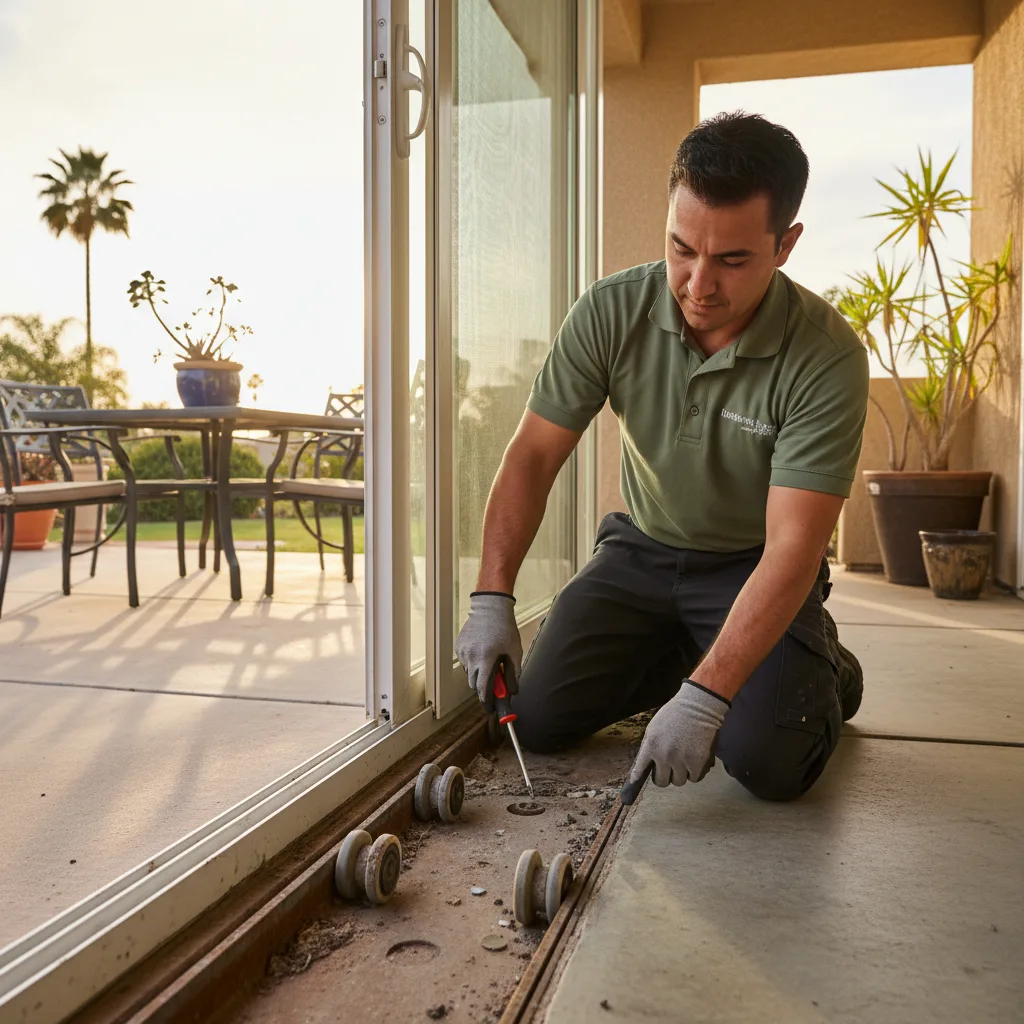
The four reasons a slider stops sliding smoothly
Most sliding glass doors in San Diego were installed between 1965 and 1990. Forty-plus years of salt air, sun, and hard water take a predictable toll. Almost every stubborn slider comes down to one of four problems:
Worn rollers. The wheels inside the bottom of your door frame degrade over time. The nylon cracks, the bearing seizes, or the wheel goes flat on one side. When that happens, the door drags instead of rolls.
Dirty or damaged track. Pet hair, sand, and debris pack into the lower track channel and act like brake pads. Even a small pebble jammed under the door can make a 150-pound glass panel feel immovable.
Bent or pitted track. The aluminum track gets dented by foot traffic, furniture legs, and decades of door weight. Once the channel is deformed, no amount of cleaning helps.
Misalignment. Doors hang from a top guide and ride on bottom rollers. If the bottom rollers are at different heights — easily thrown off by debris or failed hardware — the door tilts in the frame and binds at the top corners.
Start your diagnosis at the bottom. Slide the door halfway open and look at the track. If you see a groove worn into the aluminum, or if the track looks wavy, that’s your problem. If the track looks clean and intact, tilt the door slightly inward and peek at the roller wheels. Cracked or flat wheels confirm a roller job.
If door binding is a recurring theme around your house beyond just the slider, our post on how to fix a sticking door in San Diego covers wood swelling and hinge issues on hinged doors too.
Roller replacement: when it works and when it doesn’t
Roller replacement is the most common door repair we handle in San Diego. When the track is in decent shape, swapping the rollers typically restores full function in under two hours.
The job requires pulling the door off the track — which means lifting a panel that often weighs between 100 and 200 pounds. That part alone is a two-person task. Once the door is on sawhorses, you remove the roller access covers on the bottom edge, back out the adjustment screws, and pop out the old assemblies.
Tandem roller assemblies are the current standard for heavier doors. Each bottom corner gets one unit with two wheels running side by side on a shared axle. Tandem assemblies spread the load and last significantly longer than single-wheel designs. If your door has original single-wheel rollers from the 1970s, upgrading to tandem assemblies is worth the modest extra cost — usually $15–$30 more in parts per corner.
Roller replacement works when the track is straight and smooth. It doesn’t work when the track itself is the problem. Installing fresh rollers on a bent track is like putting new tires on a car with a bent axle.
Lubricant matters too. After installation, silicone spray is the right call for the rollers and the top guide channel. Avoid WD-40 — it’s a penetrant, not a lubricant, and it attracts dust. For the track floor itself, dry graphite lubricant keeps things sliding without collecting grit. Never use grease on a sliding door track.
Bent or pitted tracks — repair vs replace
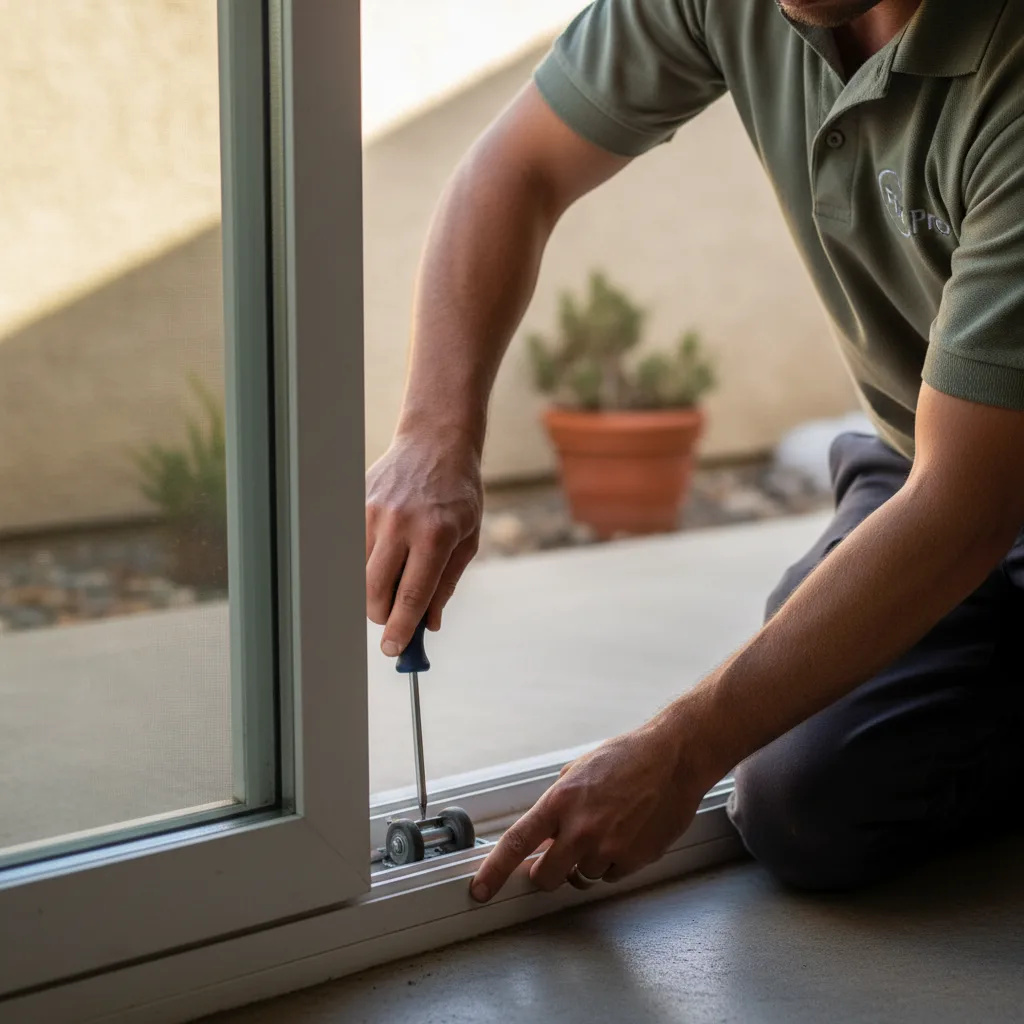
A lightly dented track can sometimes be reformed with a rubber mallet and a wood block. If you can restore the channel to a consistent width and depth, new rollers will run without issue.
Pitting is a different story. Pitting is corrosion eating into the aluminum surface, leaving a rough, cratered floor in the channel. Rollers catch on those craters at every rotation. Minor pitting can be sanded smooth with 220-grit sandpaper and the track re-coated with silicone. Heavy pitting means the track needs replacement.
Track replacement involves removing the door, pulling the old track section out of the threshold, and setting in a new aluminum extrusion. On most San Diego tract homes — your standard 1970s single-story in El Cajon, Santee, or Chula Vista — this is a straightforward afternoon job. On older homes with the track set in concrete or tile, access is more involved and the job gets into general repairs territory.
A note on track caps: many older sliding doors have a plastic or vinyl cap that snaps into the top of the lower track to retain the door. If the cap is cracked or missing, the door can jump the track. Replacement caps are inexpensive and often overlooked. Always check them during a repair visit.
When to consider full door replacement instead
If the frame itself is warped, the glass seal is broken (look for foggy or streaky glass you can’t wipe clean), or the door is aluminum-framed single pane with no thermal break, a new door is often the better long-term investment. Full replacement in San Diego typically runs $800–$2,500 installed for a standard 6-foot patio door, depending on glass type and frame material. Repair, by contrast, usually lands in the $150–$450 range for rollers and track work.
Salt-air corrosion in coastal homes
Within about two miles of the water — Coronado, Ocean Beach, Imperial Beach, Pacific Beach, La Jolla’s lower streets — sliding door hardware corrodes at a noticeably faster rate than in inland neighborhoods. The combination of salt air, marine layer humidity, and UV exposure is hard on aluminum, nylon, and steel bearings alike.
On coastal homes, a slider that was installed five years ago can show the same roller wear you’d expect after fifteen years in Mission Valley. If you’re in Ocean Beach and your patio door is grinding, don’t assume it’s too new to need service. Check it.
A few things that help slow coastal corrosion:
- Rinse the track monthly. A cup of water and a stiff brush removes salt deposits before they pit the aluminum.
- Use marine-grade silicone on the rollers and guide channel. Standard hardware-store silicone spray works, but marine formulas hold up longer in salt-laden air.
- Choose stainless steel roller assemblies when replacing. They cost a few dollars more per corner but last two to three times longer than standard steel in coastal conditions.
This same accelerated corrosion affects deck hardware, fence fasteners, and exterior fixtures. If you’re doing maintenance on a coastal home, it’s worth doing a full walk-around — our deck maintenance guide for San Diego covers what to look for on the structural side of things.
Cost ranges for repair vs full door replacement
Here’s a realistic breakdown for San Diego in 2026:
Roller replacement (both corners, tandem assemblies, labor included): $150–$275. Parts run $40–$80 for a quality tandem set. Labor is the majority of the cost because the door has to come off.
Track repair (minor dent reforming + new cap strips): $75–$150 as a standalone job, or bundled into a roller replacement for minimal added cost.
Full track replacement (aluminum extrusion, tile or concrete threshold): $200–$450 depending on access difficulty.
Adjustment and lubrication only (no parts needed): $65–$120 for a service call where cleaning, adjustment, and lubrication solve the problem.
Full door replacement (standard 6-foot aluminum frame, standard glass): $800–$2,500 installed. Fiberglass frames, impact-rated glass, or multi-panel configurations push that higher.
The repair vs replace decision almost always favors repair when the frame is structurally sound, the glass is intact, and the issue is isolated to rollers or track. A door that’s been grinding for six months hasn’t necessarily caused frame damage — check carefully before assuming the worst.
What a handyman can do same-day
Roller replacement, track repair, adjustment, and lubrication are all same-day jobs. No special permits are required for repair work on an existing door. The City of San Diego and county only require permits for new door openings or structural modifications to the opening itself — not for replacing hardware on an existing door.
A same-day visit typically includes: diagnosis, door removal, roller inspection and replacement if needed, track cleaning and assessment, adjustment to level the door, lubrication of rollers, track, and top guide, and a test cycle to confirm smooth operation.
When to call us
If the door weighs more than you’re comfortable lifting, if you can’t identify which component is failing, or if the track involves a tile threshold you don’t want to risk cracking, it’s worth having a pro handle it. Our door repair service covers sliding glass doors across San Diego County — same-day availability most days. Call us at (858) 808-6055 for same-day handyman service across San Diego County.