Mounting a flat-screen TV on a stucco wall seems straightforward until you’re holding a drill, wondering what’s behind that textured surface. In San Diego, from historic homes to modern outdoor patios, stucco is a common finish that requires a different approach than standard drywall. Drilling incorrectly can lead to a cracked wall, a weak mount, or worse, a TV on the floor.
Why stucco is different from drywall
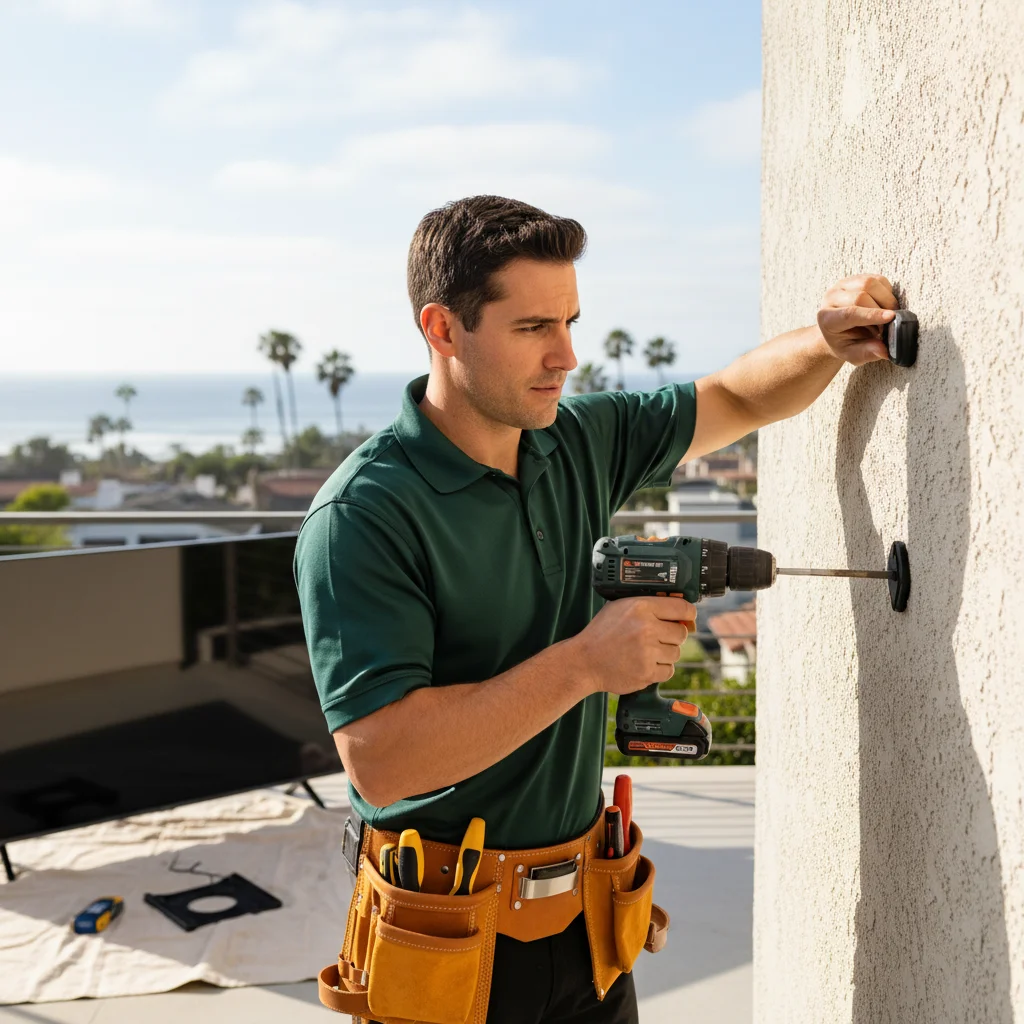
The main challenge with a tv mounting stucco wall project is the wall’s composition. Drywall is a simple gypsum board screwed to wood or metal studs. Stucco, on the other hand, is a multi-layered system.
Typically, a stucco wall consists of:
- Structural Backing: This is the house framing (wood studs) and sheathing (plywood or OSB).
- Lath: A metal mesh or wire fabric is attached to the sheathing. This lath gives the cement something to grip.
- Scratch Coat: The first layer of cement-based plaster, which is scratched or scored while wet to create a rough surface for the next layer.
- Brown Coat: The second layer, which smoothes the wall and builds thickness.
- Finish Coat: The final, textured layer that you see.
This layered system is tough and durable, but it’s also brittle. Unlike drywall, which can be easily patched if you drill in the wrong spot, fixing a large crack or hole in stucco is a more involved process. A simple mistake can turn into a significant repair. This is a key difference from standard walls, where a misplaced hole is a minor issue. If you’ve ever dealt with a simple wall issue, you know that even basic drywall repair and patching requires careful work to look seamless. Stucco multiplies that complexity.
Because you’re drilling through multiple layers of hard material, you need a powerful drill (a hammer drill is best) and the right kind of masonry bit. You also need to know what you’re anchoring into — the wood studs behind the stucco, or the concrete block wall that’s common in many San Diego homes.
Interior stucco walls — Spanish revival and 1920s homes
Many of San Diego’s most beautiful neighborhoods, like Mission Hills, North Park, and parts of Hillcrest, are filled with Spanish revival and craftsman homes from the 1920s and 30s. These houses often feature interior walls finished with plaster and lath, which feels and behaves a lot like stucco.
Mounting a TV on these walls presents unique challenges. First, finding the wood studs behind the thick plaster can be difficult. Standard electronic stud finders often struggle to get an accurate reading through the dense material. You may need to resort to the “tap and listen” method, drilling small pilot holes, or using a strong magnet to find the nails that attach the lath to the studs.
Second, the plaster can be brittle. Applying too much pressure or using the wrong drilling technique can cause significant cracking or “spiderwebbing” around the hole. It’s essential to use a sharp masonry bit and let the drill do the work without forcing it. Start with a small pilot hole and gradually widen it to the size needed for your anchor.
The key is to anchor directly into a wood stud whenever possible. The plaster and lath itself offers zero structural support for a heavy TV and mount. If you can’t align your mount with the existing studs, you must use specialized anchors designed for hollow walls, but this is a last resort and not recommended for larger or heavier screens.
Exterior stucco patios and outdoor TVs
Outdoor living is a core part of the San Diego lifestyle, and mounting a TV on a covered patio or near the grill is an increasingly popular upgrade. Most of these exterior walls are finished with stucco, but what’s behind it can vary. It could be wood-frame construction, similar to the interior, or it could be a concrete block (CMU) wall.
Knowing what’s behind the stucco is the first step. If the patio is part of the original house structure, it’s likely wood-framed. If it’s a retaining wall or a standalone structure, it’s more likely to be concrete block. Tapping on the wall can give you a clue — a hollow sound suggests wood framing, while a solid, dull thud indicates block.
When you mount tv stucco on an exterior wall, you’re not just fighting gravity; you’re fighting the elements. Moisture is the enemy. Every hole you drill through the stucco is a potential entry point for water. This makes proper sealing an absolute must, which we’ll cover in more detail below. Outdoor TV mounting San Diego projects require careful planning to ensure the installation lasts and doesn’t create future problems like water damage or mold.
The right anchors: tapcons, sleeve, plastic — and which to skip
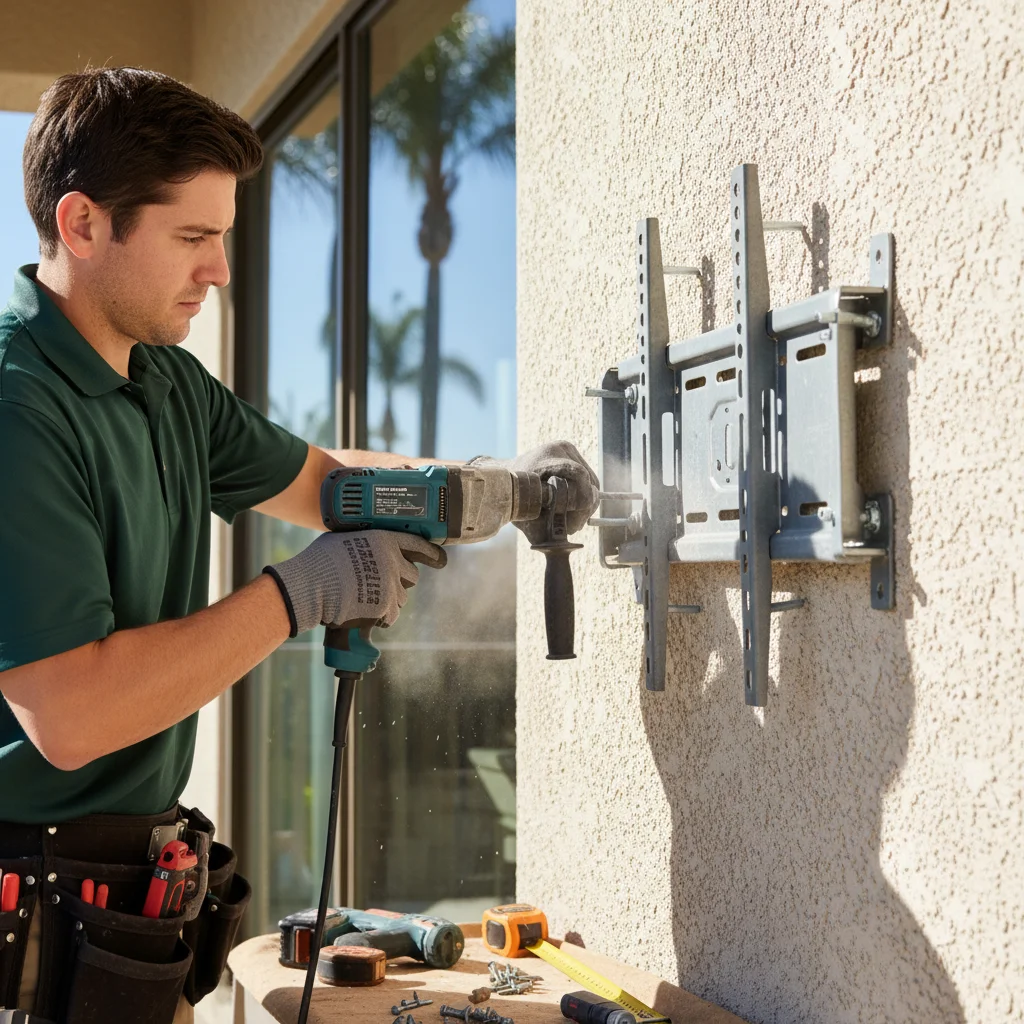
Choosing the right tv mount anchor is the most critical decision in this process. Using the wrong one is a recipe for failure. Your choice depends entirely on what’s behind the stucco.
For mounting into wood studs
If you’ve located a wood stud behind the stucco, your job is relatively simple. The best fastener is a lag bolt (often included with TV mount kits). You’ll need to drill a pilot hole through the stucco and sheathing and into the center of the stud. The lag bolt then threads directly into the wood, creating a very strong connection. Make sure the bolts are long enough to pass through the stucco layers and penetrate at least 1.5 to 2 inches into the wood stud itself.
For mounting into concrete or block
This is common for exterior patio walls or basement walls. Here, you need masonry anchors.
- Tapcon Screws: These are blue, specially coated screws designed to thread directly into concrete, block, or brick. You’ll use a hammer drill and a correctly sized carbide-tipped masonry bit to drill a pilot hole. Then, you simply drive the Tapcon screw through your mount and into the hole. They are strong, reliable, and relatively easy to install.
- Sleeve Anchors: These provide even greater holding power. A sleeve anchor consists of a bolt, a washer, and an expanding metal sleeve. You drill a hole, insert the entire anchor assembly, and as you tighten the bolt, the sleeve expands to grip the inside of the hole tightly. These are excellent for heavy TVs or when you need maximum security.
What to skip
Never, ever use the plastic anchors designed for drywall. These are meant to expand behind a thin layer of gypsum board. When used in stucco, they have nothing to grip onto and will pull out under the weight of a TV almost immediately. Similarly, toggle bolts or molly bolts are not suitable for stucco, as they are also designed for hollow drywall applications and won’t work in a solid or multi-layered wall.
Waterproofing the mount on exterior walls
For any outdoor tv mounting san diego project, waterproofing is non-negotiable. Rain, marine layer moisture, and even humidity can work their way into any unsealed penetration in your stucco. Once water gets behind the stucco, it can cause the wood sheathing to rot, the metal lath to rust, and the stucco itself to fail.
The process is simple but crucial. After you drill your holes for the anchors, apply a generous bead of high-quality, exterior-grade silicone caulk into each hole before you insert the anchor. As you tighten the bolt, the caulk will be forced out, creating a watertight seal around the fastener.
Once the mounting bracket is secured to the wall, run another bead of silicone caulk around the entire perimeter of the bracket where it meets the wall. This provides a second layer of defense, preventing water from seeping in behind the mount itself. Use a clear or paintable silicone for a clean finish. This small step takes only a few minutes but can save you from thousands of dollars in water damage repairs down the road.
When stucco TV mounting is a DIY job vs a handyman call
So, should you tackle this yourself or call in a professional?
This might be a DIY job if:
- You are mounting a small-to-medium-sized TV.
- You have confirmed there are wood studs behind the stucco and you have a reliable way to find their centers.
- You own or can rent a hammer drill and the correct masonry bits.
- You are comfortable with the process and understand the risks of cracking the stucco.
It’s time to call a handyman when:
- You’re mounting a large, heavy, or expensive TV (70”+). The risk of a mistake is too high.
- You’re drilling into a concrete block wall and need the confidence of using the right masonry anchors.
- You can’t reliably locate studs in an old plaster wall.
- The installation is outdoors and you want to ensure the waterproofing is done perfectly.
- You simply want the job done quickly, correctly, and with a guarantee.
If your situation involves any of the latter points, our professional TV mounting service is the safest and fastest option. We have the right tools and experience to handle any wall type. For a broader look at different installation types, you can also read our general TV mounting guide for San Diego homes.
When to call us
Mounting a TV on stucco isn’t just about hanging a screen; it’s about protecting your wall and your investment. If you’re not 100% confident, don’t risk it. We do this every day and can ensure your TV is secure and your wall remains pristine. Call us at (858) 808-6055 for same-day handyman service across San Diego County.